Why AI-Native Law Firms Are Emerging Now: Our Keynote at the LTC Annual Event 2026
At our LTC Annual Event on October 28, 2026, Alexander Laprell (Managing Director) and Moritz Krüsselmann (Director Legal & GovTech) gave a keynote on a topic that has shaped the legal tech conversation over the past twelve months: AI-native law firms.

At our LTC Annual Event on October 28, 2026, Alexander Laprell (Managing Director) and Moritz Krüsselmann (Director Legal & GovTech) gave a keynote on a topic that has shaped the legal tech conversation over the past twelve months: AI-native law firms.
Under the title “AI First, Lawyer Second?”, they looked at three questions: Why are these firms emerging now? How do they differ from the classic law firm model? And what is still unresolved? Below, we summarize the key points. The full presentation is available for download at the end of this post.

Why Fight Over 3 Cents When 97 Are on the Table?
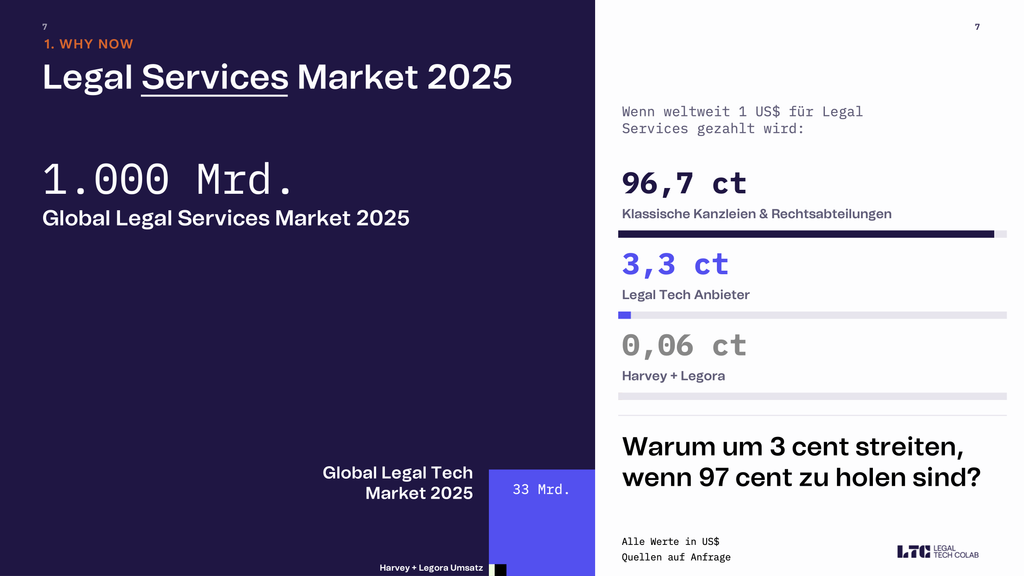
The starting point was a simple comparison. The global legal services market is worth around USD 1 trillion, while the entire legal tech market reached around USD 33 billion in 2025. Of every dollar spent on legal services worldwide, roughly 97 cents go to law firms and legal departments and about 3 cents to legal tech providers. Harvey and Legora together account for 0.06 cents.
AI-native law firms go after the larger share: they sell the legal service itself, with AI at the core of how it is delivered. Investors have taken note. Sequoia Capital sums up the thesis as “The next $1T company will be a software company masquerading as a services firm.” In the US, Norm AI (with its firm Norm Law LLP) raised USD 120 million in a Series C and Crosby USD 60 million in a Series B. In Europe, the first firms are following, among them Garfield Law in the UK and Clayfield in Germany.
Legal Services Become Scalable
Why is this happening now? The keynote highlighted three developments:
- Growth without proportional headcount: In the classic model, more work meant more lawyers, and the only lever was the ratio of partners to associates. With AI, revenue can grow while costs rise far more slowly.
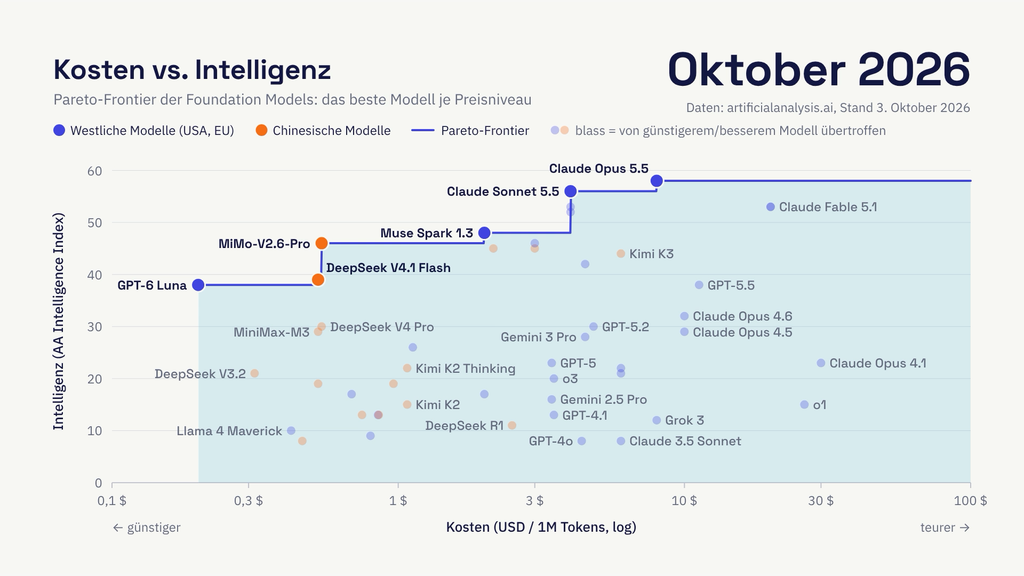
- Every model improvement is a firm improvement: At around USD 0.50 per million tokens, the best available model scored 19 on the Artificial Analysis Intelligence Index in November 2025. By October 2026, the figure was 46. A company selling an AI tool risks being overtaken by the next model release. A firm selling the work gets faster and cheaper with every release.
- Every case improves the system: Process knowledge no longer stays in the heads of individual lawyers. The system separates matter-specific knowledge from general knowledge that keeps growing.
This changes how legal work is priced and delivered. Instead of billable hours, AI-native firms charge per document, per outcome or a fixed monthly fee. They work inside their clients’ tools, for example in Slack instead of email. The skill profile of lawyers shifts as well: prompting matters less and less, while assessing AI output without redoing the work and building workflows become central.
The German Hurdles and the Open Questions
In Germany, two rules shape the model. Under the Legal Services Act (RDG), only licensed professionals may give legal advice, and the ban on external ownership (Fremdbesitzverbot) keeps outside investors out of law firms. The European Court of Justice has confirmed that this ban is compatible with EU law. One structure discussed in the keynote is a separate TechCo next to the firm: it holds IP, brand and infrastructure, can take on investors and can license its technology to other firms.
Many questions remain open. Who is liable when the AI is wrong? Will legal departments turn into in-house AI law firms of their own? Does the German fee schedule (RVG) still make sense when AI does most of the work? And is a lawyer conflicted when both sides use the same AI?
The Presentation for Download
Thank you to everyone who joined us at the Munich Urban Colab and kept discussing these questions long after the keynote. We will continue to follow how AI-native legal services develop in Germany and Europe.
